Skin Has a Sex: Hormones Dictate How the Epidermis Renews and How Quickly Wounds Heal
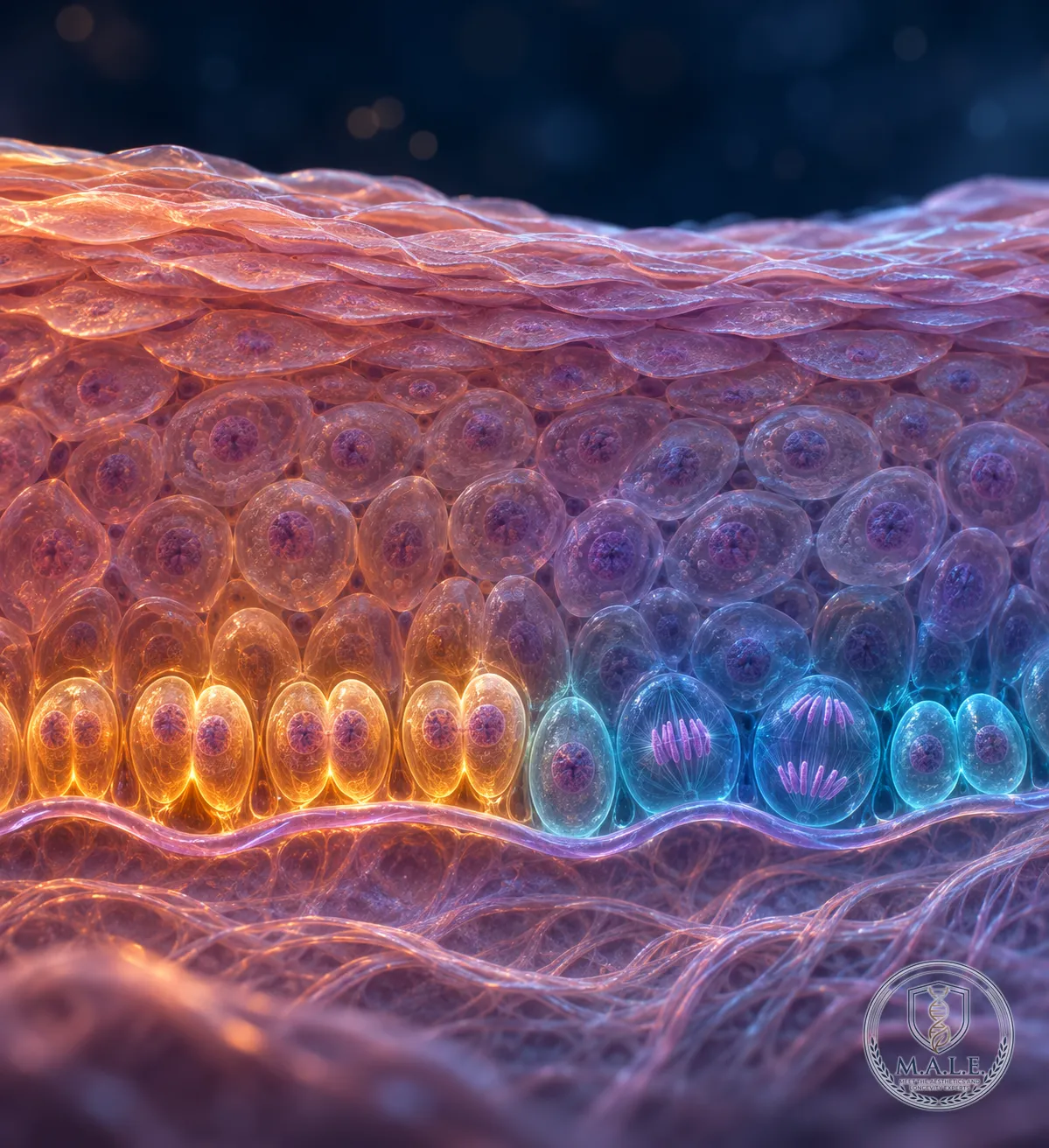
A study published on October 14, 2026, in Nature shows that skin does not renew in the same way in females and males. The team led by Prof. Cédric Blanpain (Université libre de Bruxelles), in collaboration with Prof. Benjamin Simons' group (University of Cambridge), tracked the same stem cells in the epidermis of live mice for five months and discovered that sex hormones set the "pace" of skin renewal and wound healing.
What Was Discovered
Researchers used intravital microscopy (repeated imaging through the skin of a living animal) to track genetically marked cells in the basal layer of the ear epidermis and their descendants. Two results stand out:
- A hierarchy in the basal layer. The data support a two-compartment model: stem cells give rise to intermediate progenitors (of the "transit-amplifying" type), which can only divide a limited number of times before differentiating and migrating to the surface. This addresses a decades-old debate about epidermal organization.
- An unexpected sexual dimorphism. In females, the two "sister" cells resulting from a division often make the same decision at the same time: both divide or both differentiate. In males, their behavior is much less synchronized.
The Role of Hormones
After castration, male skin cells began to behave similarly to those of females; administering dihydrotestosterone (DHT) restored the male pattern. Androgens thus accelerate the differentiation and detachment of cells from the basal layer. In females, ovariectomy reduced stem cell proliferation and almost nullified synchronization, while estradiol restored proliferation. On human skin reconstructed in the lab, testosterone also accelerated stem cell differentiation, suggesting that part of the mechanism exists in humans as well.
“We set out to understand how skin renews and whether there is a hierarchy with stem cells at the top. We were surprised to discover strong differences between females and males.” — Dr. Dan Engelman, the study's first author
Faster Healing in Females
Wounds on the backs of female mice closed significantly faster, especially in the first few days after injury, partly because stem cells activated earlier and more coordinately. As healing progressed, the difference between sexes diminished.
Why It Matters for Clinical Practice
Aesthetic medicine works daily with epidermal renewal: peels, ablative and fractional lasers, microneedling, surgical procedures. The study provides a plausible biological explanation for clinically observed differences between women and men in healing rates and suggests that hormonal status (androgens, estrogens, menopause, hormone therapies) could matter in planning procedures and recovery. In the long term, the authors see applications in treating burns, surgical wounds, chronic ulcers in diabetic patients, and in preventing skin cancers.
Study Limitations
- The main observations (sister cell synchronization, faster healing) were made in mice, on ear and back skin.
- In humans, the only evidence is the effect of testosterone on in vitro reconstructed skin; there are no clinical data yet.
- The healing advantage in females is clearest in the early days and diminishes later.
- The study does not offer treatment recommendations; it remains to be seen how much these differences apply to patients.
Personalizing treatments based on sex and hormonal profile is one of the themes that bring fundamental research closer to the aesthetic medicine clinic, and such discussions have their place at M.A.L.E.
Sources
- Original paper: Engelman D., Hochstetter J., Bauduin A., Patil S. et al., Simons B. D., Blanpain C. “Sexual dimorphism in epidermal stem cell dynamics”. Nature, published online on October 14, 2026. DOI: 10.1038/s41586-026-11159-2
- Press release from Université libre de Bruxelles (October 14, 2026): “La peau a un sexe: femelles et mâles ne renouvellent pas leur peau de la même façon”
- English version of the release, Newswise: “Skin Has a Sex: Females and Males Do Not Renew Their Skin in the Same Way”
- ScienceDaily (October 18, 2026): “Scientists discover that male and female skin play by different rules”